Hands-on chart
The best time to visit Cape Reinga, season by season
Light and season
Sun and temperature through the year
Choose a month to compare sunset, day length and the usual temperatures, then pick your travel date.
Sunset
Feb
February is the warmest month, with a 24.4 °C average high at Kaitaia.4
Mar
March is one of the driest months, after the holiday rush.1
Aug
August brings the most rain of the year.1
Sunset is worked out for the 15th of each month on New Zealand time at Cape Reinga. Temperatures and day length come from the NOAA station at Kaitaia, 92 km south of the cape, 1991 to 2020.
The best time to visit Cape Reinga depends on what you want: dry days, quiet paths or long evenings. Here are the months, the hours, the wind and the clothes that make the trip work.
Editorial team, capereingatour.top · Updated November 8, 2026 · A 7 min read
Weather at the top of the country
Cape Reinga weather has one constant: wind. According to the Department of Conservation, the headland is highly exposed, that conditions turn quickly and that strong winds blow often.5 Across Northland, DOC describes a moderate climate of warm, humid summers and relatively mild, wet winters, with winds that mostly blow from the south-west.6 Expect sunshine and squalls in the same afternoon, whatever the season. Pack for both and you will enjoy the visit whatever the sky does.
No month is free of rain. DOC says winter is the wettest season, but heavy rain may fall in any month, and the heaviest falls come with easterly winds.2 A day that starts gray in Paihia or Kaitaia can clear by the time you reach the lighthouse, and the reverse is just as likely. Check the forecast on the day itself rather than the evening before, and pack a jacket either way because conditions at the top can differ from the towns to the south.
The temperatures quoted here come from the NOAA station at Kaitaia, a town 92 km due south of Cape Reinga (the road is longer at 111 km), averaged over 1991 to 2020.4,7 Out on the headland the wind bites harder than in town, so pack a windproof layer whatever the figures say.5 Read them as a seasonal picture rather than a forecast for the rail. Treat a calm, sunny forecast as a gift and make the most of it, because the next front is never far away on this coast.
Temperatures and rain through the year
Summer at Kaitaia is mild rather than hot. January averages a daily high of 23.8 °C and a low of 15 °C.4 February runs warmest, averaging a high of 24.4 °C.4 On the open headland, with the wind off the sea, those days feel warm in sunshine and cooler out of it. Bring a layer even for a midsummer visit. Evenings cool quickly once the sun drops, especially near the water, so keep a fleece handy.
Winter is cool but rarely cold. In July the average daily low at Kaitaia is 8.6 °C, and in August it falls to 8.3 °C.4,4 Daytime highs in those months average 15.6 °C.4,4 Pack a waterproof jacket and accept that some winter days will be spent watching rain sweep across the sea. A warm hat, gloves and dry socks in the bag make a long winter day out far more pleasant. Wet days can still bring striking views over the sea.
DOC gives mean rainfall of 992 mm a year at Cape Reinga and 1440 mm at Te Paki, with higher totals likely in the hills.12 The driest months are January and March, and the most rain falls in August.1 That pattern makes late summer, especially March, the sweet spot for many travelers: the weather is still settled and the late December rush has passed.3 Even in a dry month, carry a light rain shell just in case.
Month by month
Temperatures and daylight through the year
- Jan9.8 h
- Feb10.7 h
- Mar11.6 h
- Apr12.7 h
- May13.6 h
- Jun14.1 h
- Jul14.0 h
- Aug13.2 h
- Sep12.2 h
- Oct11.1 h
- Nov10.1 h
- Dec9.6 h
Months compared by sunless hours at mid-month and days with 2.5 mm or more of precipitation. NOAA station Kaitaia, 1991 to 2020.4
Choosing the best time to visit Cape Reinga
Tourism New Zealand defines summer as December to February, autumn as March to May, winter as June to August and spring as September to November.8 In practice, the best time to visit Cape Reinga for settled weather is from December to April, with March often the most comfortable month. DOC's rainfall pattern, with January and March the driest, supports that choice.1 Spring and autumn days can be just as rewarding if you pack well.
Crowds are the other half of the decision. DOC names late December and early January as the most crowded weeks.3 If you can, travel in February or March, when the days are still long but the car park is calmer. Northland Inc notes that tours to Cape Reinga and Ninety Mile Beach run from Kaitaia in summer, which widens your choice of departure points then.14 For sunrise at Cape Reinga, check the sunrise time against the 7am gate opening first.13
Winter visits have their own appeal. Winter falls outside the busiest weeks, which DOC puts in late December and early January.3 A stormy sea over the bank can be a sight in itself. The trade-off is more rain and shorter days, and on the coach day both the beach drive and the sandboarding depend on tides and weather in any season. Leave slack in the itinerary if the cape is a must, so one wet forecast cannot cancel the trip. A flexible booking with free cancellation helps here too.
Your priorities
When should you go?
Pick the line that matters most on your trip.
If I want dry weather
Go in March
DOC names January and March as the driest months.1
If I want few people
Avoid the holiday peak
Late December to early January is the busiest time.3
If I want warmth
Go in February
Kaitaia averages its highest highs then.4
If I want flowers
Go in December
Pōhutukawa flower red around Christmas.11
If I want a sunset
Mind the gate hours
The car park gates close at 8.30pm.13
Sunrise and sunset at Cape Reinga
The hour you arrive matters as much as the month. For a calm visit DOC points you to the first or last hours of the day, away from the 11 am to 3 pm peak.3 If you stay nearby, you can arrive before the busy window opens or linger after it closes. Early starts also mean softer light on the lighthouse for photos, and fewer people in the frame when you take them. Late light suits it too.
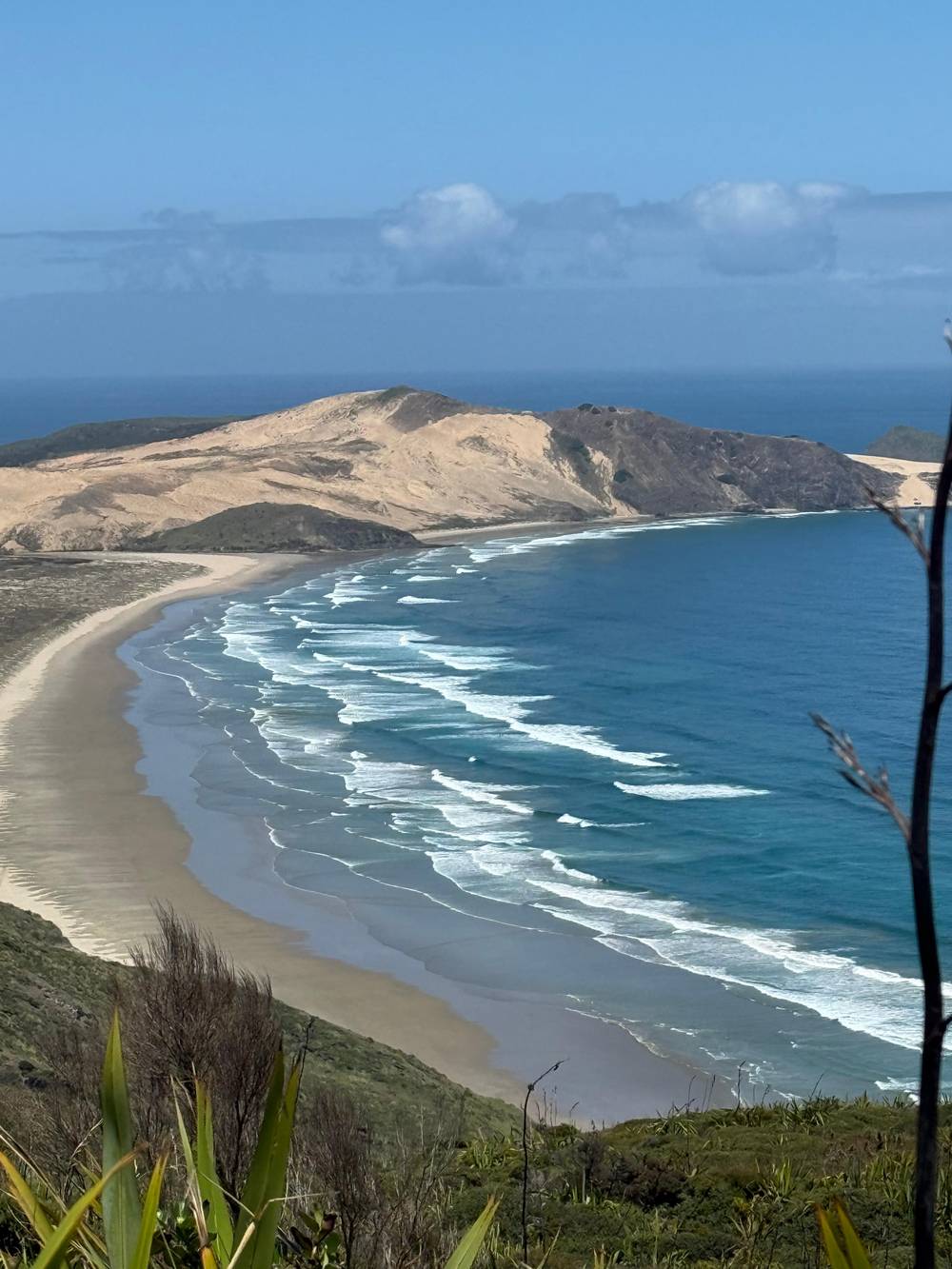
Dawn lights the Pacific side first, and the lighthouse stands out against a brightening sky. At sunset at Cape Reinga the sun drops toward the Tasman Sea, on the western side of the headland.18 Daylight swings widely: Kaitaia gets 14.4 hours of sun at mid-December against 9.9 hours at mid-June.4,4 Both make the long drive north feel worth every kilometer, whatever the season, so plan your arrival time with care.
One rule shapes every evening plan. DOC keeps the car park gates locked from 8.30pm to 7am.13 In midsummer the sun sets late, so check the time against the gate hours and leave the headland before they close. In winter the timing is easier, and you can stay for sunset and still reach the car with time to spare. Bring a torch for the walk back to the car in the dusk, and watch your footing.
Pick a day
What a Cape Reinga day trip costs for your group
Set your group size, then pick a dry day for the trip.
Compare 2 alternatives
What a Cape Reinga day trip costs for your group
Set your group size, then pick a dry day for the trip.
- Paihia coach day11 hours · price per person from $114
≈
View - Small-group day10 hours · price per person from $135
≈
View
All amounts are from-prices on GetYourGuide, converted at the ECB reference rate. Exact prices are shown at booking.
A year at the cape
What each season brings
What to wear to Cape Reinga
Dress for wind first. A windproof jacket over a warm layer works in every season, because the headland is exposed and the weather turns quickly.5 In summer, add sun protection: DOC's kit list for the reserve includes sunscreen, a hat and sunglasses.16 Comfortable shoes with grip matter more than style, since the paths are paved but steep in places.15 Gloves are welcome on a winter morning at the rail.
Summer brings insects. DOC says mosquitoes and sandflies are plentiful, and recommends insect repellent.17 Wasp numbers are high from January to April, and DOC advises light-colored clothing, because wasps are more likely to attack dark objects if their nest is disturbed.9,19 Keep that in mind for a picnic at Tapotupotu later in the day. Cover sweet drinks and food when you eat outdoors.
If your day includes sandboarding, plan for sand. Pack spare clothes, as the Paihia coach day listing advises. Northland Inc tips socks on the dunes in summer, since the sand turns very hot underfoot.20 So what to wear to Cape Reinga comes down to layers, sun gear, closed shoes and spare clothes in a bag, plus water to drink on the way. A small daypack keeps it all together on the walk.
Video
A trip to Cape Reinga and the giant sand dunes
Chander Shama on YouTube · Until you tap play, no video is loaded.
the cape is very exposed, the weather changes fast and strong wind is common
Pack for the cape
What to wear and bring
Clothes3
Sun and bugs3
Seasons in the landscape
The land changes color with the year. Pōhutukawa, the trees that cling to the coast, flower bright red around Christmas, which has earned them the title of New Zealand's Christmas tree.11 The famous tree on the headland is a pōhutukawa too, so a December visit puts the cape's most symbolic tree in its season.21 Look for their crimson flowers along the coastal cliffs as you drive north toward the cape.
Rarer flowers bloom nearby. Bartlett's rātā, a tree found in the Te Paki area, bears white flowers in November or December.10 In spring, pink and white mānuka flower along the Pandora section of the coastal track.22 For walkers, the shoulder seasons combine color with cooler temperatures, which suit the longer tracks better than the heat of January. Bring a phone or camera with a close-up mode for the flowers.
Even the dunes follow the seasons. DOC says the dunes tend to advance in dry seasons and pull back in wet ones.23 After heavy rain, DOC warns that sudden downpours raise stream levels, so tracks can slow down or become impassable.24 Before any visit, check the NIWA forecast for the cape that DOC links to, and let the weather pick your day if you can.25 A spare day in the plan is the best insurance there is.
FAQ
The short answers to your questions.
Which month is best for Cape Reinga?
What is the weather like at Cape Reinga?
DOC warns that the headland is exposed, conditions change quickly and strong winds are frequent.5
What is the wettest month at Cape Reinga?
How warm is it in summer?
Kaitaia averages a February high of 24.4 °C.4
When is Cape Reinga least crowded?
The peak runs 11 am to 3 pm; the busiest weeks fall from late December into early January.3
Can I watch the sunset at Cape Reinga?
Gates shut at 8.30pm and reopen at 7am, according to DOC.13
Where can I check the forecast?
DOC links to a NIWA weather forecast for Cape Reinga/Te Rerenga Wairua.25
Sources
- Department of Conservation · Ara Pou (pou trail) ↩
- Department of Conservation · Ara Pou (pou trail) ↩
- Department of Conservation (doc.govt.nz) · Cape Reinga/Te Rerenga Wairua Lighthouse Walk ↩
- NOAA · Global Summary of the Month, Station Kaitaia (NOAA GHCN NZ000093012), 1991 to 2020 ↩
- Department of Conservation (doc.govt.nz) · Cape Reinga/Te Rerenga Wairua Lighthouse Walk ↩
- Department of Conservation · Ara Pou (pou trail) ↩
- Department of Conservation (doc.govt.nz) · Cape Reinga/Te Rerenga Wairua Lighthouse Walk ↩
- Tourism New Zealand · Cape Reinga ↩
- Department of Conservation · Te Paki Coastal Track ↩
- Department of Conservation · Ara Pou (pou trail) ↩
- Department of Conservation · Pohutukawa ↩
- Department of Conservation · Ara Pou (pou trail) ↩
- Department of Conservation (doc.govt.nz) · Cape Reinga/Te Rerenga Wairua Lighthouse Walk ↩
- Northland Inc (northlandnz.com) · Top of the North ↩
- Department of Conservation (doc.govt.nz) · Cape Reinga/Te Rerenga Wairua Lighthouse Walk ↩
- Department of Conservation · Te Paki Coastal Track ↩
- Department of Conservation · Te Paki Coastal Track ↩
- Department of Conservation · Cape Reinga/Te Rerenga Wairua heritage ↩
- Department of Conservation (doc.govt.nz) · Tapotupotu conservation campsite ↩
- Northland Inc (NorthlandNZ, official economic development and tourism agency) · A Weekend Getaway to the Far North ↩
- Department of Conservation · Te Paki Recreation Reserve ↩
- Department of Conservation · Te Paki Coastal Track ↩
- Department of Conservation · Ara Pou (pou trail) ↩
- Department of Conservation · Te Paki Coastal Track ↩
- Department of Conservation · Cape Reinga/Te Rerenga Wairua Lighthouse Walk ↩