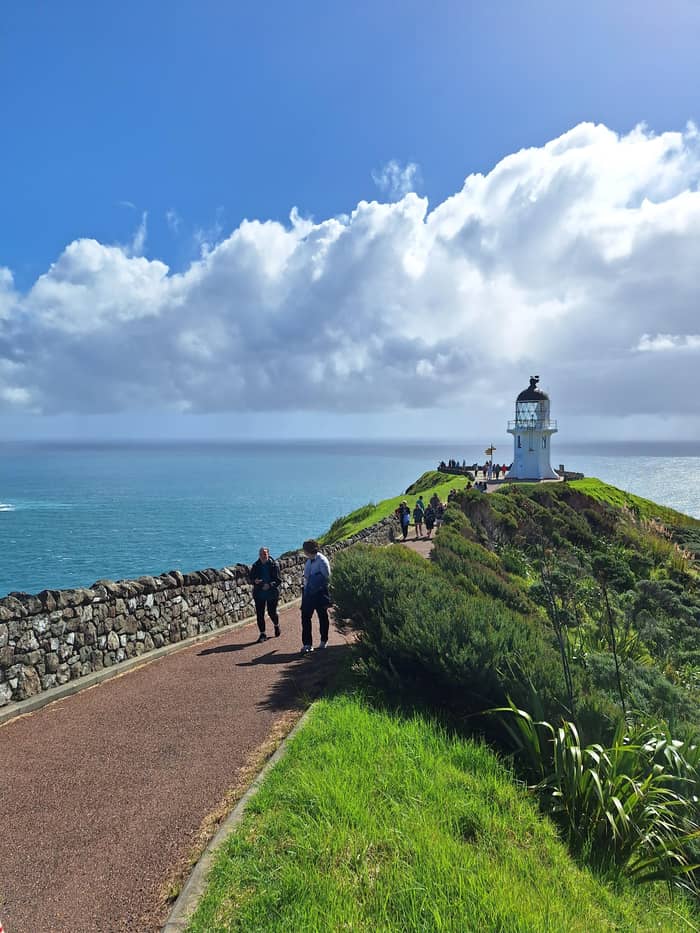
Most sacred
The headland
Te Rerenga Wairua
- Marked byPōhutukawa and lighthouse
- TreeTe Aroha
- RuleNo food
Clickable checklist
Preparation · 7 items
Check things off as you go; your progress is kept on this device.
0 / 7 ready
You are ready. Only the date is left: your day out to the lighthouse and back.
Secure your spotCape Reinga in Māori is Te Rerenga Wairua, a place of departure for spirits and the most sacred site of the iwi who care for it. Here is what the name means, what you will find there and how to act as a guest.
Editorial team, capereingatour.top · Updated November 8, 2026 · A 7 min read
Cape Reinga in Māori is Te Rerenga Wairua, and the Department of Conservation uses both names side by side. The Department of Conservation explains that the cape marks the point from which Māori wairua, or spirits, return to their traditional homeland.1 Northland Inc calls it the leaping place of the spirits, a place of departure as well as a meeting place of great oceans.6 Both names point to the same headland and the same meaning.
The English name carries part of the story too. DOC describes the spirits slipping down a root into the sea beneath the headland, and so into the reinga, the underworld.7 It is worth learning both names before you go, and using Te Rerenga Wairua when you talk about the place. Saying it carefully is a small courtesy worth practicing before the trip, along with the names of the places you will pass on the way north.
The wider region has a name of its own. DOC notes that the Far North peninsula is often called Te Hiku o Te Ika, the tail of the fish, from the story of Māui fishing up the North Island.8 Seen on a map, the long thin peninsula really does look like a tail. Te Rerenga Wairua sits at its very tip, where the land gives way to open sea on every side. Standing there, the sense of an ending is hard to miss.
Tikanga at the cape
| Topic | Please | Source |
|---|---|---|
| Food | Do not eat at the cape | DOC |
| Water | Drinking water is fine | DOC |
| Ashes | Do not bury or scatter | DOC |
| Rubbish | Take it all away | DOC |
| Pets | None, including dogs | DOC |
| Pace | Take your time | Northland Inc |
Visitor protocols as the Department of Conservation and Northland Inc publish them.4,5,18,19
Why is Cape Reinga important? DOC says no place in New Zealand carries more spiritual weight for Māori.14 Ngāti Kuri, the iwi of the area, describe Te Rerenga Wairua as the most sacred place within their rohe, and the place where the spirits of their people begin their final journey home to Hawaiki.2,15 That is the context for every rule you will meet on the path. Knowing that before you arrive changes how the visit feels.
It is also a landscape full of human history. DOC counts over 1000 recorded archaeological sites in the Te Paki area, many holding evidence from the earliest periods of human settlement in New Zealand.9 All of them are protected under the Heritage New Zealand Pouhere Taonga Act 2014, and damaging or interfering with them is an offense.16 If you come across shell middens or old terraces, look and leave them be.
DOC links the place to Kupe, the great navigator, who is said to have made Te Rerenga Wairua the departure point for his descendants' spirits on their way back to Hawaiiki-A-Nui.10 The places Kupe named range from Te Ara Wairua, the spirits' pathway, to Te Rerenga Wairua itself.17 Even a short visit puts you on ground that has carried meaning for many centuries. Walk the path with that long history in mind.
Through the centuries
Earliest times
Sites hold evidence of the earliest human occupation.9
Kupe
Kupe set the cape as the spirits' point of return.10
1642
European ships reach the Far North.11
1941
The light moves from Motuopao to the headland.12
1966
The Crown buys the whole Te Paki farm.13
Today
Ngāti Kuri call it the most sacred place in their rohe.2
The spirit tree at Cape Reinga is a pōhutukawa, and DOC gives its name as Te Aroha, a solitary tree on the headland of Te Rerenga Wairua.3 DOC describes it as perhaps the most famous pōhutukawa in Māori legend, a small tree, battered by wind, that holds on to the cliff near the cape.22 Many visitors expect a grand tree and are surprised by how modest it looks from the rail. Look down from the viewing area toward the point to find it.
Its age is often given as about 800 years.23 DOC calls it the 800-year-old tree, said to stand guard over the mouth of a sacred cave used by spirits bound for the next world.23 Tourism New Zealand gives it more than 800 years, while Northland Inc notes that its exact age is impossible to confirm.24,25 Treat the number as tradition rather than a measurement. Either way, it has stood through a great many storms.
Pōhutukawa are known as New Zealand's Christmas tree, because their red flowers blaze around Christmas time.26 DOC also warns that pōhutukawa are under potential threat from myrtle rust, a fungal disease now established in New Zealand.27 Admire the tree from the viewing area, stay on the paved track and never climb down toward it: the drop-offs here are steep and the place is tapu.
Your visit
Depth, time and company shape the right choice.
If I want the story from the iwi
Join the Ngāti Kuri day
Tribal members host a small-group day.
If I want a quiet moment
Go early or late
DOC finds it busiest from 11 am to 3 pm, and in late December and early January.20
If I am bringing lunch
Eat at Tapotupotu
DOC suggests it as the place to eat.21
If I want to remember someone
Visit, but scatter nothing
DOC asks that no ashes be left at the cape.5
If I want an easy day
Take the coach from Paihia
The lighthouse is among its named stops.
Places in the story
Most sacred
Te Rerenga Wairua
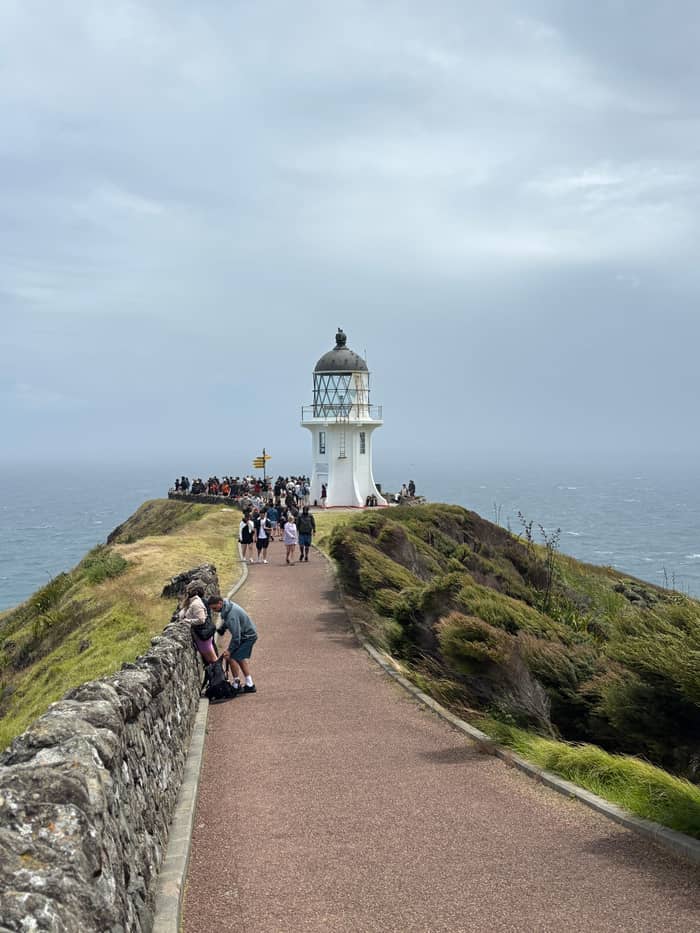
Ancestral memory
Kapowairua
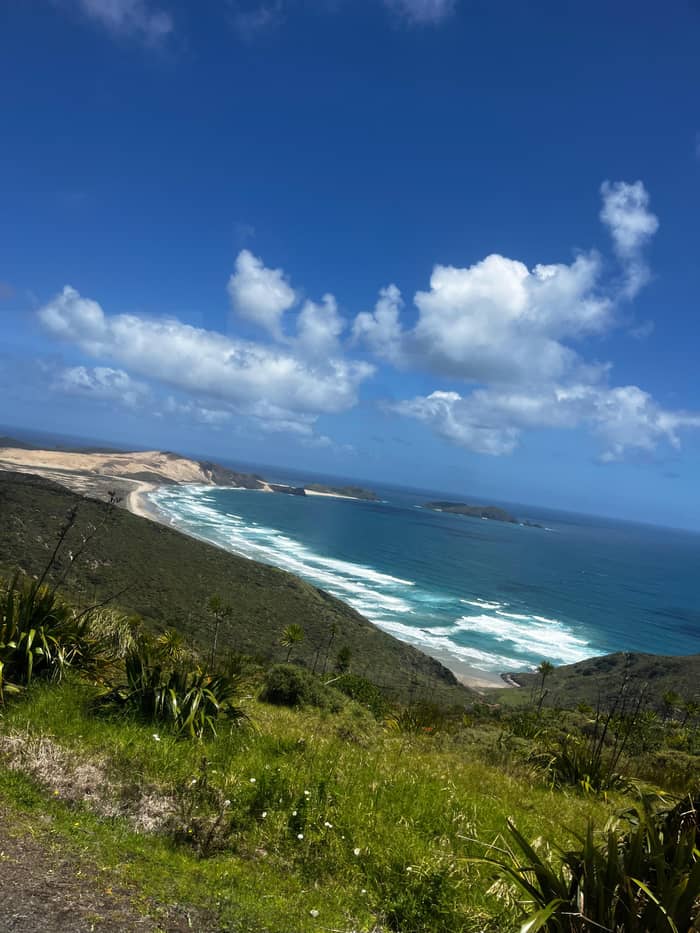
Final resting point
Manawatāwhi
DOC shares a public telling of the journey, and it is best read in its words rather than embroidered. After death, Māori spirits are said to travel up the coast and across the windswept land to the pōhutukawa on the headland of Te Rerenga Wairua.29 Along the way, DOC says, Haumu is the point where the spirits' pathway, Te Ara Wairua, comes together.30 Read it as a belief held by living people today.
DOC adds that departing spirits would mark their passing with bundles of grass, nikau leaves or knotted plants, and that they followed a lonely ridge from the beach to Te Reinga.31,32 From the headland they descend by a root into the sea, then travel under the water to the Three Kings Islands, bid a last farewell and return to the land of their ancestors.7,33 On a clear day, those islands are visible from the rail.34
Ngāti Kuri speak of Manawatāwhi, the Three Kings, as the last resting place, where spirits pause before they leave Aotearoa behind.35,33 Nearby Kapowairua, Spirits Bay, carries the meaning catch my spirit, according to Northland Inc.36 These are living beliefs, not legends from a closed book, so listen more than you ask, and accept that some knowledge is not shared with visitors. Respect for that line is part of visiting well.
Go with a guide
Set your group size and compare a cultural day with the classic coach.
Compare 3 alternatives
Set your group size and compare a cultural day with the classic coach.
≈
View≈
View≈
ViewAll amounts are from-prices on GetYourGuide, converted at the ECB reference rate. Exact prices are shown at booking.
Ngāti Kuri describe themselves as descendants of the first inhabitants and founding peoples of the far northern peninsula, Te Hiku o Te Ika.37 Their rohe is generally described as everything north of a line drawn between Maunga Tohoroha (Mt Camel) on the east coast and Hukatere on the west.38 When you visit Te Rerenga Wairua, you are a guest of the iwi as well as of the Department of Conservation.
Their role is practical as well as spiritual. DOC notes that Ngāti Kuri run the campground at Tapotupotu, the closest one to the cape.39 Access questions on the lighthouse track go to a Ngāti Kuri helpdesk, which DOC gives as 0800 837 254.40 The rules at the cape are their tikanga, explained by DOC for visitors who may not know them. Following them is how visitors honor that care, day after day.
If you want to hear the story from the people themselves, one listing offers a small-group day hosted by Ngāti Kuri tribal members, with visits to culturally significant sites, subject to conditions, and 90 Mile Beach. It runs for 11 hours, with guiding in English and Māori. That is a different experience from a sightseeing coach, and it suits travelers who want depth over speed.
Video
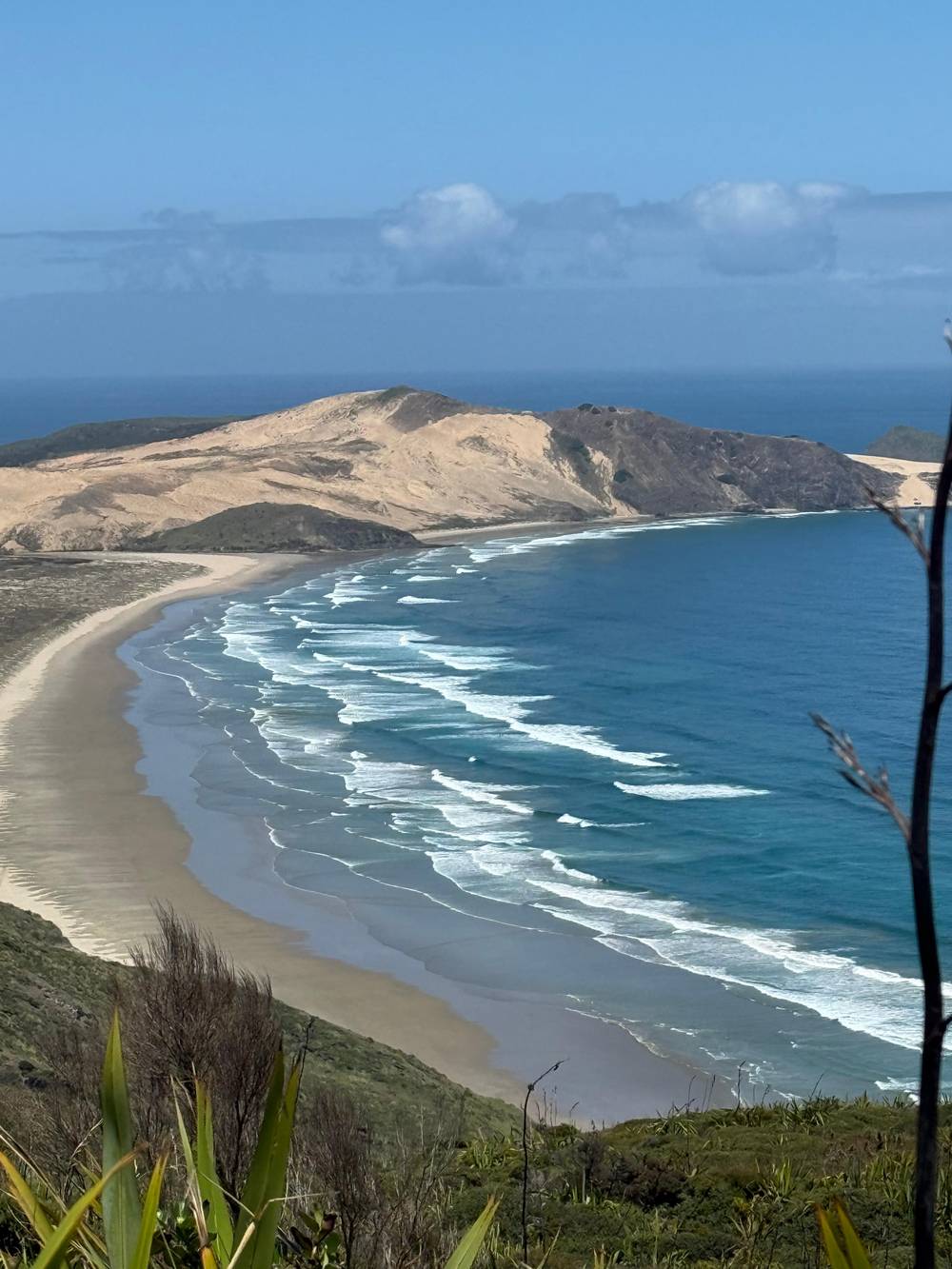
Waitakere Walks on YouTube · Until you tap play, no video is loaded.
It is the place where the spirits of our people begin their final journey home to Hawaiki.
The core request is simple. DOC's request is that no food be eaten at Te Rerenga Wairua at Cape Reinga, and it says drinking water is fine.4 Northland Inc goes further and asks people not to eat or drink at the site.41 The safest course is to keep food and drinks packed away on the headland. DOC suggests Tapotupotu, a short drive away on gravel, as the place to eat, and recommends Sandy Bay on the coastal track.21,42
DOC also asks people not to bury or scatter the ashes of loved ones at the cape, because it is a sacred site; remembering them there is welcome.5 There are no rubbish bins, so everything leaves with you, and animals stay at home, dogs among them.18 Northland Inc sums it up: across this land of sacred sites, all visitors must tread lightly and with respect.43 Small acts like these are what the iwi ask of every guest.
Respect also means slowing down. Northland Inc advises taking your time at the cape, because it is not a place to rush.19 Keep voices low near the headland, stay on the paved track, and step aside for anyone who has come to remember someone. If you are with a tour, follow the guide on where to stand and how long to stay. A few quiet minutes at the rail are worth more than a hurried photo, and they are what most people remember.
FAQ
DOC writes the place as Cape Reinga/Te Rerenga Wairua; wairua means spirit.1
DOC asks visitors not to eat food there under tikanga; drinking water is fine.4
DOC says burying or scattering ashes at the cape is not culturally appropriate.5
DOC suggests Tapotupotu, a gravel-road drive of 5-10 min, which has toilets.21
A small-group day hosted by Ngāti Kuri tribal members is offered, with lunch.
Sources
Heading for the top of the North Island? Ask a real person here.